Manual Voice Regeneration
Bodywork and Voice
Own Hands on techniques
Anatomy
Seminars

Manual Voice Regeneration
Areas of Practice
-
reduced vocal endurance and vocal fatigue in singing
-
functionally inefficient patterns of tension perceived in the context of voice use, involving the jaw, neck, face, larynx and tongue; reduced freedom of movement in the temporomandibular joint
-
limitations in respiratory mobility during singing
-
pressed or effortful modes of phonation and reduced vocal flexibility
-
difficulties in the practical implementation of vocal technique associated with an as yet insufficiently differentiated perception of voice-relevant structures
Manual Voice Regeneration does not replace medical and therapeutic assessment or treatment. It is conceived as a non-therapeutic, body- and perception-oriented accompaniment to voice, breathing and the regulation of tension within a vocal and artistic context. Where appropriate, I am happy to refer to medical practitioners and voice or speech therapists from my network.
Aims
-
differentiation of proprioceptive awareness of the respiratory and vocal apparatus and of vocal function, forming a foundation for work with breath and voice
-
accompanying support of regenerative processes during periods of increased vocal demand (e.g. stage performance, speaking-intensive or teaching professions)
-
fostering free and efficient vocal motor coordination, as well as mobility of voice-relevant structures
-
support for the regulation of tension within the vocal system (including the jaw, larynx, tongue, facial, cervical and thoracic regions, as well as the respiratory musculature)
-
refinement of breath coordination in speaking and singing, and support of breath–voice integration
-
accompanying work on fascial mobility and elasticity within a vocal context
-
support in developing constructive strategies for dealing with stress-related tension in the singing apparatus
Bodywork in a vocal context
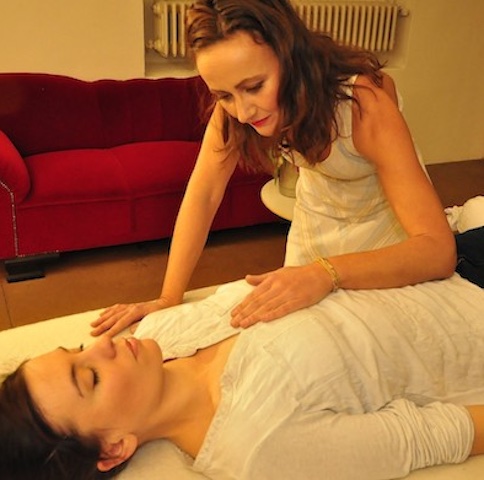
My own experiences as a client led me to develop a manual approach specifically tailored to singers and Speakers.
In teaching practice, I occasionally observe situations in which progress reaches a plateau because the body is not yet able to embody certain aspects of the pedagogical work — for example, allowing the jaw opening to adapt naturally to vowel, dynamic level and pitch. Certain patterns of tension may have become habitual, and through touch it can become perceptible that further potential exists on the path towards a freer voice.
In particular, I value work in the oral cavity and jaw area as a valuable tool within vocal work, supporting the development of a renewed awareness of these structures and encouraging ease and mobility.
My work has been informed, among other influences, by my training and continuing professional development in Visionary Craniosacral Work®, visceral and laryngeal osteopathy, various myofascial techniques, anatomy, a range of meditation practices, and trauma-informed approaches.
Session: 55 minutes – €95
Three-month package: 3 × 55 minutes – €270
Bookings for appointments in the studio can be cancelled up to 48 hours in advance.
If cancelled too late, the full lesson fees must be paid, regardless of reason of cancellation.
Especially sessions in the studio are limited, and I need this time to re-assign the appointment. Thank you for your understanding.
Own Hands On
Body structures love touch! There are many times we turn to touch automatically, like when we massage aching muscles, press certain acupuncture points or stretch muscles that have too much tension. Through vocal coaching, directed touch leads to results much more quickly because we can communicate with our bodies directly, without involving our heads. “Loosen up your jaw!” “Lift your soft palate!” – you’ve heard you should do them, but aren’t shown how to? With `directed touch` we can learn to manually analyze our bodies. That helps us to clearly understand the structures and improve performance. Feedback from regular touch practice improves flexibility and brings us into better contact with our vocal instrument, keeping our bodies and voices supple.
According to the needs of your voice, I teach you a set of techniques that you can apply in your singing routine.
These exercises are also very effective for voice regeneration when you are on tour or have to sing challenging vocal parts. After voice infections or injuries, together with the Vocal Straws, hey help rebuilding your voice.
Seminars
Manual Voice Regeneration
In this seminar, you will learn manual Own Hands-on techniques for independent application that support perception, ease and the organisation of movement in singing. The work focuses, among other areas, on the jaw, tongue and larynx within a vocal context.
Contents
-
manual Own Hands-on techniques
- introduction to the functional anatomy of voice-relevant structures
-
regenerative singing exercises, including SOVT exercise
Focus Areas
-
accompanying support of vocal recovery processes following periods of high vocal demand (e.g. concerts, rehearsals, speaking-intensive phases)
- fostering ease and freedom of movement in the jaw, tongue and laryngeal areas
-
perception of functional patterns of tension and movement
- understanding, perceiving and consciously engaging voice-relevant structures
-
independent Own Hands-on practice as a complementary approach to vocal work
The Way to the free voice with Own Hands on
Workshop Overview
This workshop centres on the development of a differentiated awareness of vocal and bodily patterns in singing. We explore habits and approaches that may influence the free flow of the voice, and investigate functional relationships through individual experience.
The workshop is particularly suitable for singers who
-
experience their free vocal flow as restricted
-
perceive an effortful or pressed mode of voice production, or experience tensions in the neck and laryngeal area as limiting
-
experience their vocal development as stagnating despite regular tuition and practice
-
find it challenging to embody pedagogical instructions, or wish to deepen their perception of voice-relevant structures
Through awareness-based exercises in combination with simple Own Hands-on techniques, we explore individual patterns of tension and movement and practise influencing these more consciously within singing. The work includes simple singing exercises as well as participants’ own repertoire.
Focus Areas
-
deepening perceptual awareness of the lower jaw, neck, tongue, larynx, swallowing musculature, upper jaw, soft palate, facial musculature, ribcage, shoulders and pelvic floor
-
exploration of which aspects of vocal technique may still be in development, so that auxiliary tension patterns become unnecessary in singing
Short individual teaching sequences are included within the group setting to support this process.